

Please Note: The following is an early draft for an upcoming book. If you would like to recieve more early drafts of the book as we develop it - a lot of companion material that is going to be cut down from the final version to keep things concise, feel free to respond to this and let me know. I can always publish it here on Substack, ha!
What sparked the tech revolution? Did it have something to do with the transistors? How did chips come to be and how did it really launch the PC era? From Nvidia’s gaming GPUs to the mega-powerful H100s, let’s talk about the technology supercharging AI, as we know it. In this article, we will dive deeper into the story of breakthroughs that flipped the tech world upside down.
Story Time.
Early Computers (1946-1958)
In 1946, the first general purpose digital computer came into existence. This was called ENIAC and was powered by Vacuum Tubes. However, vacuum tubes were large, bulky and fragile, often taking up entire rooms and needing careful handling. This made them harder to scale because integrating more components was just not easy.
The Invention of the Transistor (1947)
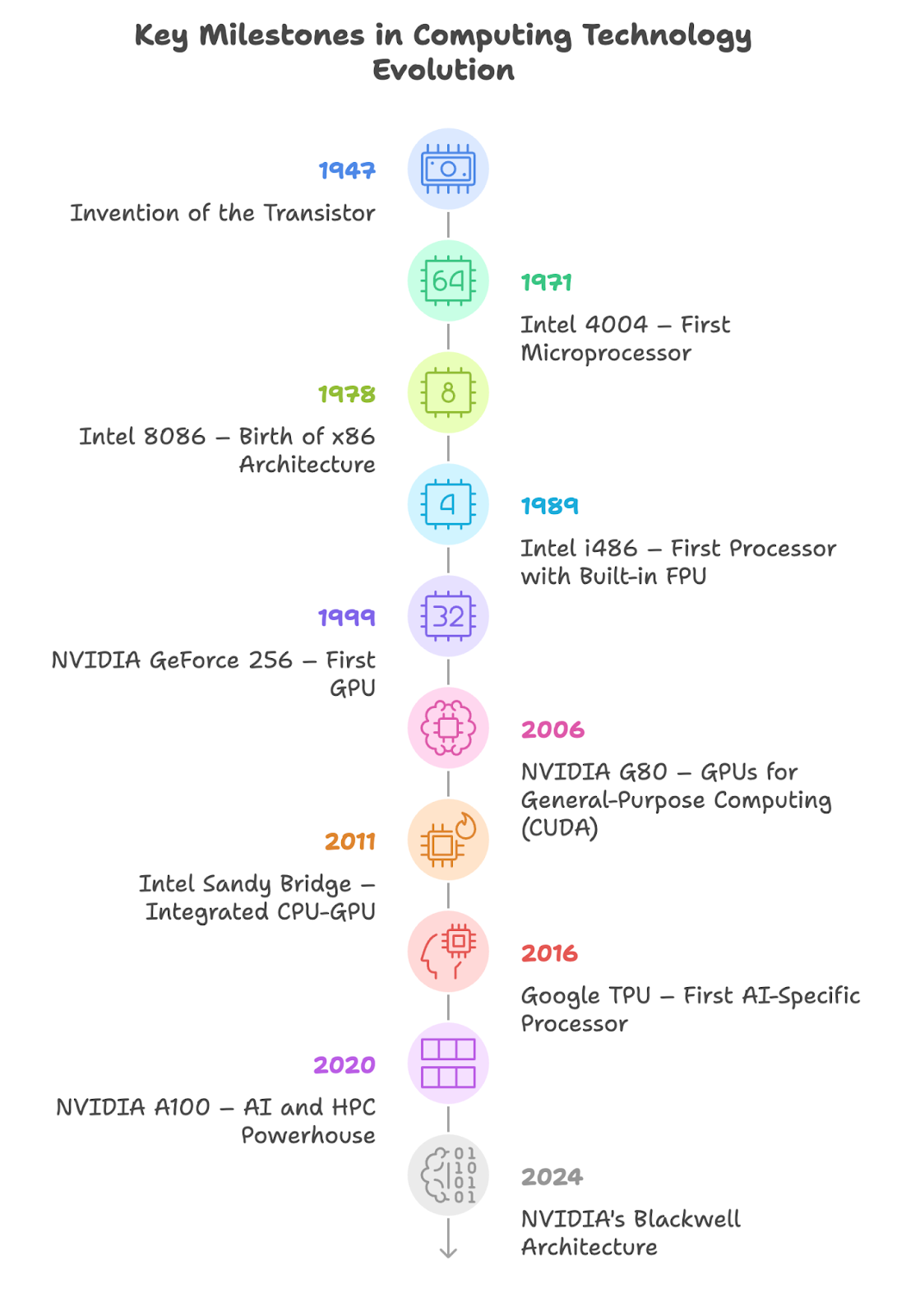
In 1947, Bell Labs created what is called a Transistor. The transistor instead was smaller and used wires which meant computers could finally be miniaturized and were more durable, reliable and power efficient.
Integrated Circuits Revolutionize Computing (1958)
In 1958, Jack Kibly from Texas Instruments created an Integrated Circuit (IC). This was a big deal. Why? Because instead of connecting different processor components by wires, you could now fit them onto a single chip.
Instruction Sets and Early Microprocessors (1970s–1980s)
Once, people got their hands on the IC - they realized what if we could create an instruction set so everything doesn’t need to be programmed from bare bones over and over again and thus came CISC (Complex Instruction Set Computing) and a more efficient RISC (Reduced Instruction Set Computer) in 1970s to 1980s. Around the same time, more people started experimenting with RISC and thought what if we could simplify processor instructions - we could actually speed things up - a core idea we still use today.
And that’s where things start to get more exciting.
The Birth of the Microprocessor (1971–1978)
In 1971, Intel launched 4004, the world's first commercial microprocessor. It wasn’t crazy fast but it was groundbreaking because it packed an entire processor onto a single chip. Mad, right? Well, come 1978 and Intel released their next microprocessor 8086, which also introduced x86 architecture for the first time. This x86 architecture has been the backbone of every PC you’ve used till date, from IBMs mainframes to today’s laptops. The 8086 was faster and smaller than the 4004, small enough to now pack it in a personal computer.
Personal Computers and Early GPUs (1980s–1999)
And naturally, the 80s saw the rise of the personal computer revolution, giving us Apple Computers. 80s nerd clubs were now heavily exploring how we could render visuals and graphics onto these microprocessors. And boom, in 1999, the first GPU was introduced by Nvidia - it was called GeForce 256, primarily designed for gaming and visual applications. Intel was quick to adopt and integrate it within their microprocessors (Intel Pentium Processors) and AMD started to emerge as a competitor.
The Rise of GPUs
The 2000s were however a turning point for GPUs. In 2006, NVIDIA released G80 GPU which introduced CUDA, which allowed GPUs to handle general purpose tasks like physics simulations and machine learning. This was the first time people realized GPUs weren’t just for games - they could be used for all sorts of computationally heavy tasks.
Integration of CPU and GPU
On the CPU side, Intel was working on a new line of processors and in 2011, they introduced Sandy-Bridge Architecture. It was a significant milestone because it allowed the CPU and GPU to be integrated on a single die. Before Sandy Bridge, computers often had the CPU and GPU in the same system, but they were physically separate components. GPUs existed as graphic cards that were plugged into the motherboard while CPU handled general-purpose tasks. Sandy-Bridge Architecture changed the game by integrating the GPU directly into the CPU die. Once integrated on a single component, this meant several advantages. First, they could share unified memory access which meant faster rendering and reduced overall latency since the data transfer didn’t have to go over the motherboard. Second, a single chip consumes less power than separate CPU and GPU components. This meant faster applications and better battery life on laptops and other portable devices without compromising on speed and allowing to make the devices lighter. You see why Apple used Intel processors.
Specialized Processors as AI becomes mainstream
In 2016, Google realized they could speed things even faster by developing a new processor like Tensor Processing Unit (TPU) that were specialized for deep learning, making them incredibly efficient for AI tasks, unlike those general-purpose CPUs and GPUs. In 2017, AMD made a strong comeback in the CPU market with their Ryzen Processors, giving Intel some serious competition for the first time in years.
Apple and ARM Architecture
On the consumer side, Apple was starting to get frustrated with Intel. Intel relied very heavily on their x86 architecture which was designed for traditional desktops and laptops but wasn’t well suited for the faster, more efficient, lighter (more portable) devices that Apple had built its fan following for. And moreover, they were dependent on Intel’s design and release cycles. Intel was struggling with delays in its 10nm and 7nm processes, which slowed Apple’s innovation. So, in 2020, Apple made a big announcement. They released a new line of macbooks with M1 chips using ARM architecture (which is designed around RISC instead of CISC used by Intel, i.e. the x86 architecture). This allowed Apple to eliminate fans in some devices (like the Macbook Air) and improve thermal efficiency without compromising on efficiency and performance. Furthemore, Apple could now innovate much faster, after breaking free from Intel’s roadmap allowing them to innovate on their own schedule.
Hyper-Specialized AI Processors: The GenAI age
Around the same time, in 2020, we entered the age of hyper-specialized processors where Nvidia launcher A100, designed specifically for large scaled AI training and with the transformer architecture (“Attention is All You Need”, 2018) taking off with GPT-1 and GPT-2, Nvidia released H100s in 2023 built on the Hopper architecture, which was optimized for AI workloads with transformer engine and large-scale data processing capabilities.
In 2024, Nvidia introduced Blackwell architecture, to succeed the H100, that could speed up Large Language Model (LLM) inference by 30x and reduce the energy consumption up to 25x. As of 2025, we are expecting the AI Chip Market to grow 24% from 2024 reaching $91.96 billion with several significant announcements around AMD’s Instinct MI350 AI Accelerator, Intel’s Gaudi3 AI Accelerator, Hailo’s Edge AI Chips, Intel’s Jaguar Shores AI Chip, Huawei’s Ascend 910C and Nvidia’s yearly announcements we will know when times comes. Additionally, the Stargate Project, a collaboration between NVIDIA, OpenAI, Oracle and Softbank aims to invest $500 Billion in AI infrastructure over the next four years to drive substantial advancements in AI hardware and software ecosystems.
Can you guess where it’s headed?
Citation:
Aryan, A., & Liu, Z. (2026). Deep dive into GPU and TPU architectures for LLMs (Chapter 1) in GPU engineering for AI Systems (early draft), Packt Publications.
Interesting article, although there seems to be a typo - I'm guessing that Jack Kibly invented the integrated circuit in 1958, not 1858.