

We have all seen the pre-LLM Data Scientists and ML Engineers feeling a sense of FOMO when LLMs became the standard AI models because a lot of manual iterative work on building a good model was suddenly gone overnight. You could simply call an API, and hook it up with your vector databases and it worked.
2023 marked Phase 1 of a lot of engineering work being automated almost overnight.
But on the other hand in 2023-2024, there were suddenly a lot of new jobs created suddenly with hundreds of new AI startups with new roles like Prompt Engineer, AI Engineer, Context Manager, AI Product Manager that came into picture.
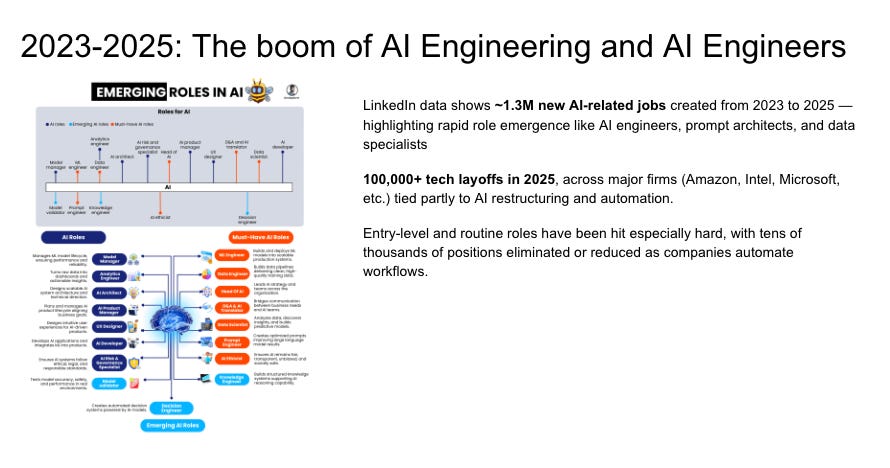
Jobs that didn’t exist pre‑2023 are now core parts of organization structures. Hiring is concentrated in high‑skill AI fields, while non‑AI and routine entry roles shrink and “AI fluency” became a key differentiator.
Fast forward 3 years, hello 2026!
Models are used as-is either as APIs or OSS models from Hugging Face
vLLM, Ray etc has optimized serving.
Cursor/Windsurf etc became the defacto modes to code entire apps in days now instead of weeks
Ground reality,
RAG-applications
~72% of RAG implementations either fail or underperform. Why?
as datasets grow, semantic search precision degrades and latency climbs
simple vector RAG struggles past ~10k–50k docs.
RAG systems require both retrieval and generation for each query this leads to higher cost and slower throughput than plain LLM inference
Agentic
Around 38% of enterprises run pilots vs only ~11% in production which is a 27‑point death valley. Most agentic initiatives live on whiteboards and demos; only a small fraction reach stable real‑world deployment.
Massive failure modes emerge as agents multiply. In real workflows, coordination errors and step‑by‑step breakdowns are common with reliability deteriorating sharply with multi‑agent coordination.
Informal industry data suggests only ~23–35% of companies (incl new startups) actually have agents running in production, while the rest remain POCs or get scrapped due to brittleness.
MultiAgent
Beyond the big-tech, very few if any success at scale. Because inference scaling is costly. Why? More agents = more latency + more failure points.
AI isn’t the turnkey solution many expected and most early enterprise deployments crash, burn, or deliver sub‑par results.
But this isn’t to say AI is failing. This is basically correction. What I mean by that is 2023–2025 was driven by hype → over promises → eventual failures.
But since end 2025, I am already seeing some patterns:
Simplification of Agentic Pipelines - Standardized agent pipelines & observability reduce failures
This would mean projects salvaged from 27% → ~60% success rate
vLLM - High-throughput orchestration frameworks + GPU optimization → latency cut by 50–70%
LLM inference optimization & model composability → cost per request cut by 40–50%
TLDR;
AI engineering isn’t failing. But it’s changing, once again. How?
AI engineering now emphasizes integration, iteration speed, and creativity, not manual coding. Even interviews are about tradeoffs now, instead of leetcode. This is felt in interviews, not just talk (see the screenshot below). This is now standard as Cursor/Windsurf tools are commonly used in take-home exercises.
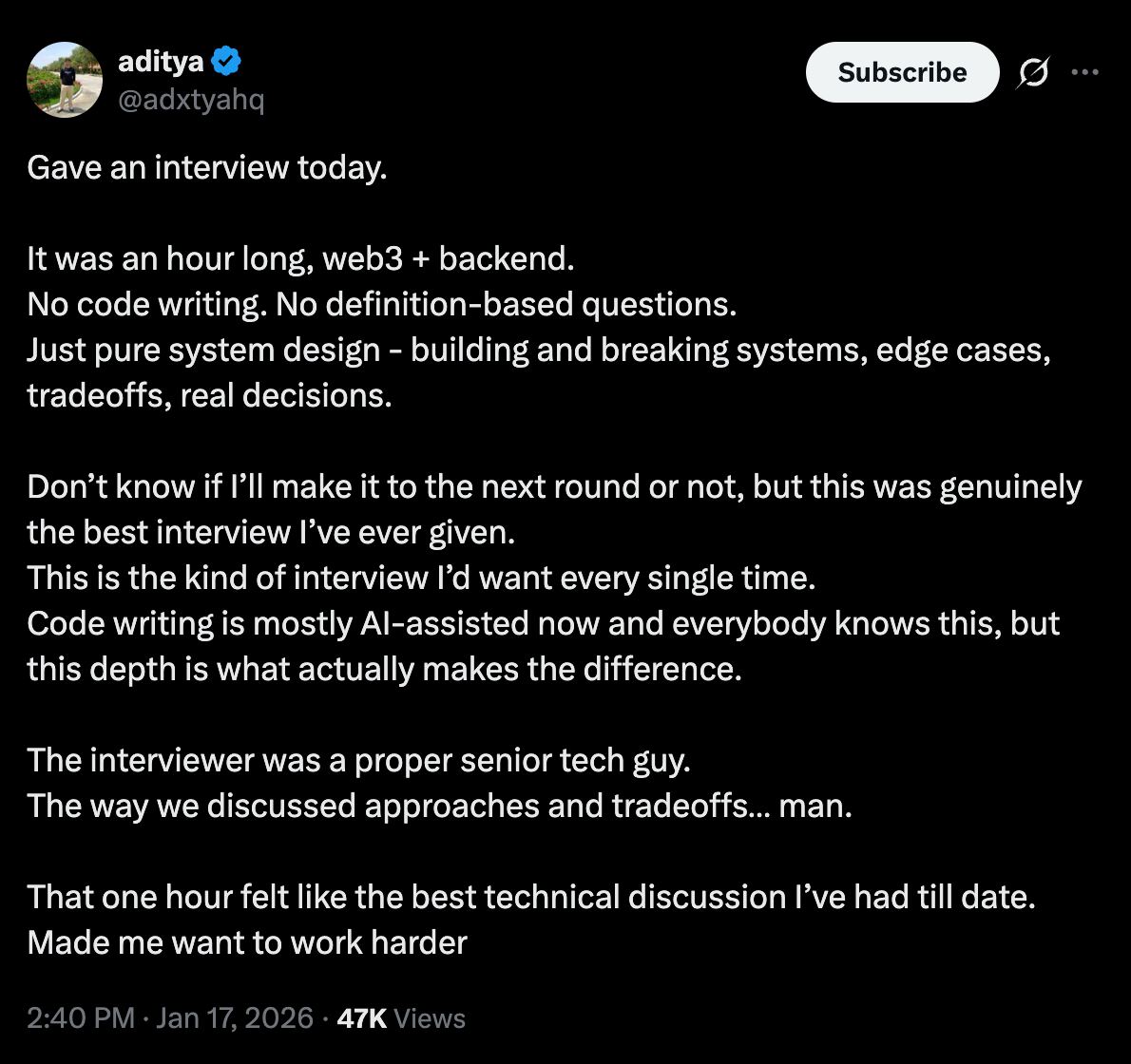
Infact, this is slowly becoming the reality at many startups and enterprises out there. I have talked to several vertical AI companies in the last few months at work and this is already a norm across most of the US already.
This means standing out as an AI Engineer now isn’t just about having a RAG or Agentic project in your portfolio.
But success now as an AI Engineer relies very heavily on being a good Systems Engineer. So what does it actually mean to be a good systems engineer in the AI context of 2026?
Here are the core skills that matter most right now, not the flashy new framework of the week, but the timeless (and evolving) engineering principles that fix brittleness, cut latency/cost, and make agents actually survive contact with real users and data.
Architecture Design
You need to treat the entire AI application as a composable, observable system, not just a prompt + model + vector store.
This means understanding failure propagation: how a 5% retrieval recall drop cascades into hallucinations, infinite agent loops, or 3× cost spikes.
Good systems engineers decompose problems (retrieval → reranking → generation → tool use → verification). This means being able to define clear interfaces between components, and design for graceful degradation instead of chasing 99.9% end-to-end perfection.
Mastery of production infrastructure for inference and orchestration
vLLM, TensorRT-LLM, Ray Serve, or Triton aren’t “nice-to-haves” anymore. They are table stakes for anyone moving beyond toy latency. You need to know how to optimize KV cache, batching, quantization (FP8/AWQ/GPTQ), speculative decoding, and continuous batching.
Now importantly you need to know when to use which one to slash inference cost and latency by 50–70%. How to add Kubernetes + autoscaling + GPU-aware scheduling! That’s what makes you precious on the teams.
Observability, monitoring, and evaluation at scale
While a lot of the basic monitoring and evals esp will be sucked into the models by end of 2026 and 2027. As of now, most people are using Langfuse, LangSmith etc for tracking token usage per step, retrieval precision@K, agent step success rate, hallucination flags, tool-call accuracy.
What if I told you that you leave so much performance with those tracing tools. The key is to build your own workflows using OS tools out there.
Reliability engineering
LLMs are probabilistic which means agents multiply uncertainty.
Most people do not know how to implement circuit breakers, retries with exponential backoff, human fallback loops, bounded execution (max steps, max tokens, time boxes), guardrails, output schema enforcement (JSON mode, function calling), and verification layers (self-consistency, critique-revise, RAGAS-style scoring). A lot of this can be baked within your API.
Your goal should be to turn 38% pilot survival into 60%+ production reality.
Context and data flow engineering
We all know the buzzword is no longer “prompt engineering”, it’s now context engineering.
But how do you design intelligent chunking, hybrid retrieval (dense + sparse + graph + SQL)? How to implement metadata filtering, reranking (cross-encoders, LLM rerank), compression (LLMLingua, context summarization), and state management across long-running agents?
This is where simple vector RAG die at scale. We talked about this (check the talk slides below) but context engineered pipelines thrive here.
Tradeoff mastery under real constraints
Interviews have shifted from LeetCode to questions like “Given 4× A100s, 100k QPS, $0.50/1M tokens budget, and 500k docs, design a reliable agent for X.”
You need to be able to reason about cost-latency-accuracy-recall tradeoffs, when to fine-tune vs. in-context, single vs. multi-agent, deterministic routing vs. LLM router, etc.
Integration and operability mindset
AI systems no longer live in isolation. How do you build clean APIs, handle auth/rate limits, integrate with existing enterprise systems (Snowflake, Databricks, auth providers)?
How do you ensure auditability/compliance, and design for rollback when models upgrade or APIs break? This is no longer someone else’s job.
In short,
the golden skill in 2026 isn’t “I built an agent with 7 tools.”
It’s “I built an agentic system that runs reliably at 1/3 the cost, with 5× better uptime, observable failure modes, and clear paths to 10× scale.”
The hype is gone. What’s left is real impact and real compensation for engineers who can ship systems that survive production. The future belongs to those that can build and scale reliable systems, understand the tradeoffs and justify the costs.
The products built with this “first principles thinking” engineering will own the Agentic and RAG markets respectively.
If you want to level up your systems and model serving muscle and position yourself at the front of this maturation wave, I’m teaching exactly some of this thinking in my upcoming course: AI Systems Design & Inference Engineering (starting February 21st).
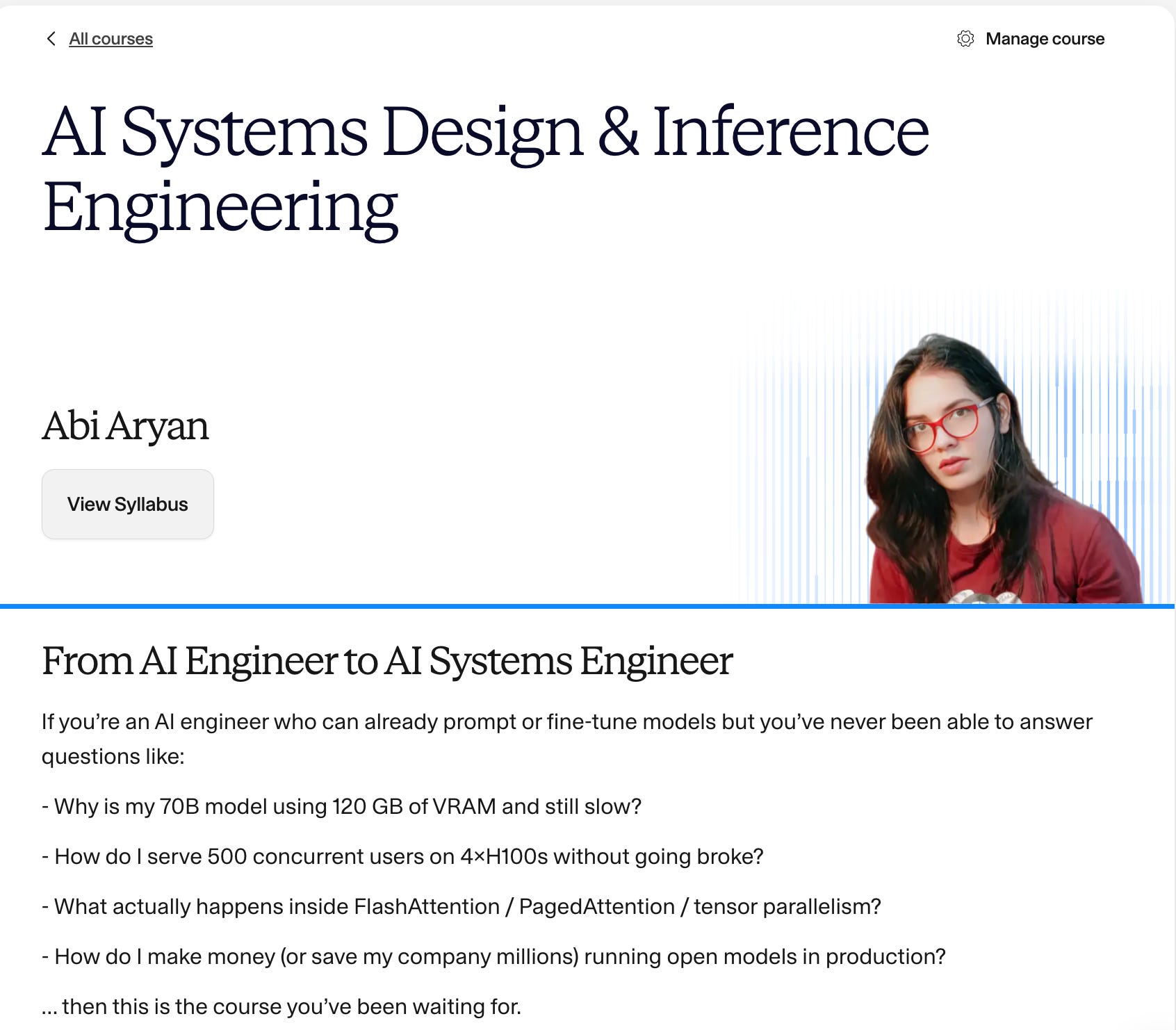
Over these 6 intensive weeks, we’ll go from being HF basics to building, profiling, optimizing, and deploying full inference stacks for 1.5-405B models, including stateful agentic workloads.
You’ll master the production realities that separate toy projects from paid, scalable systems and learning how to design an inference engine and optimize the existing ones for your use case.
PLEASE NOTE: This is a serious infra course, not an agentic applications course.
I’ll see some of you in the cohort. Let’s build systems that actually last.
Cited:
The 27-point gap between pilots and production is a stat I hadn't seen quantified like that. What's wild is that even the failing agents are consuming massive inference. A single agent task can hit an API 50 to 200 times before producing anything useful. So the demand engine is running full throttle regardless of whether the output survives contact with production. I covered the economics of this from the inference provider side recently: https://medium.datadriveninvestor.com/who-profits-when-ai-models-are-free-b71ae03f4167